RadExPro - Land Reflection Seismic Data - New Tutorial!
20 March 2023
RadExPro have released a new tutorial, which carefully goes through how to process near surface land Seismic reflection (CDP) data effectively in RadExPro. They provide example input data (Onshore seismic profile data in SEG-Y format) which you can process alongside the step by step tutorial guide. The guide will go through the following steps:
Basic CDP data processing
Geometry input until stacking and time-to depth conversion (minimum processing graph) - focus on the SH-wave profile
The guide will also help you process the P-wave data (do not follow the Subtraction of left & right shot part of the tutorial as this is used for the excitation of the SH-waves perpendicular to the profile line)
You must be familiar with the CDP theory method and basic seismic processing (reflection)
RadExpro also provide the full project dataset (fully processed data) to refer back to.
The Tutorial Steps will be as follows:
Loading input data into the project
Geometry assignment and CDP binning
Subtraction of “left” and “right” shots (miss out this step for P-wave analysis)
Control of assigned geometry with the use of linked crossplots
Recently, Geomatrix Earth Science Ltd acquired a new borehole probe which we have now added to our rental pool. The probe is an acoustic borehole imager (also known as the acoustic televiewer), which is a new second generation quick link QL40ABI-2G probe, developed by Mount Sopris Instruments and BHTV technology. The QL40ABI-2G uses new re-designed sensor & electronics with a 96dB, 10msps A/D converter coupled to a 150mA DSP digital signal processor. This signal processor processes the data in real time for each individual ultrasonic wave, increasing the signal detection dynamic range and enhances its usability in the field.
As with most of the Mount Sopris borehole probes, the QL40ABI-2G is a Quick link tool which can be linked up with other Mount Sopris QL probes for multiple logging applications. The QL40ABI-2G is supplied as a QL bottom sub, however, the operator can use it as a stand alone tool (non-stackable) if required.
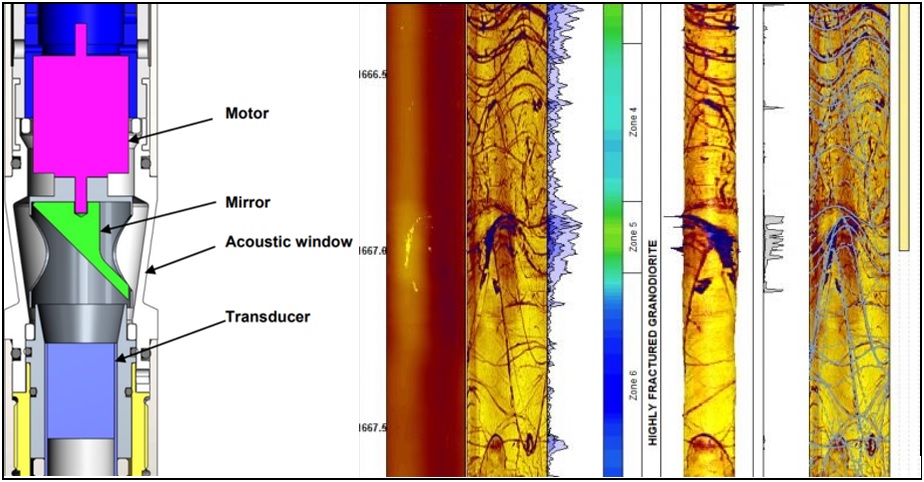
As you deploy this televiewer down your borehole, the instrument transmits ultrasonic pulses via its fixed transducer (a piezoelectric ceramic crystal) and rotating mirror at roughly 1.2MHz frequency. The generated wave propagates through the acoustic head and borehole fluid until it reaches the fluid/wall boundary and is reflected back. The acoustic televiewer measures/records the amplitude travel time and a digital image/ scan is captured of the borehole wall. There is also an option for multiple echo recording by recording the reflected acoustic wave and the use of further sophisticated algorithms to detect and classify specific echo’s.
Fig 1. Image shows the components of the QL40ABI-2G acoustic televiewer probe (left) and the digital image scans of a heavily fractured borehole wall. Image courteously provided by mount Sopris instruments.
Features:
. The acoustic televiewer has the latest firmware updates/ developments which allows the user to infer the thickness of the wall, in more adverse borehole conditions.
. Improved signal detection/dynamic range
. Increased travel time resolution
. Multiple operating modes, such as in PVC cased boreholes the instrument can record the echo of the PVC and the borehole wall, this can be extended to steel cased boreholes (i.e can derive casing thickness and evaluate rate of corrosion)
Comparison of traditional cross hole seismic array to Distributed Acoustic sensing (DAS) system - Bristol University
13 April 2022
At the end of January 2022, Joanna Holmgren and Max Werner from Bristol University and BGS’ Jon Chambers visited the UK Geoenergy Observatory (UKGEOS) in Glasgow to conduct a small seismic borehole survey at the abandoned coal mines that have been repurposed by UKGEOS for geothermal research.
The aim of the fieldwork was to see how well an emerging seismic monitoring technique called distributed acoustic sensing (DAS) performs in a shallow, urban geothermal setting. Over three days, the team from Bristol University recorded DAS down a 90 m-deep borehole, deploying hydrophones alongside the fibre-optic cable as a benchmark.
For further information about the project and a seek peak at the initial results refer to the UKGEOS blog post
WellCAD 5.5
11 March 2022
WellCAD V.5.5 - New Release!
This new version of the WellCAD software has been updated to include a number of new features and upgrades. This involves changes to the image & structure interpretation package with Linear structure picking, Partial picks, Terzaghi correction and revised Borehole imaging (BHI) import.
These will allow the user to better image core linear structures and lineation’s and interactively pick the orientation, present plus classify structures. Partial picks allows individual or multiple selection of visible segments in the sinusoid to derive the depth of the planar feature/eroded bedding plane. The software’s statistical analysis functions have expanded, allowing the user to analyse the structural picks along the borehole axis, providing a weighting factor on the acute angle between the structure and axis (Terzaghi correction). BHI tools replace the FMS/FMI import wizard enabling tool configuration adaption to the imported data channels allowing you to view the data prior to final conversion with fast and easier processing.
Fig 1 Shows the new structure features 1) Partial Picks, 2) Terzaghi Correction 3) BHI import. All images courteously provided by ALT.
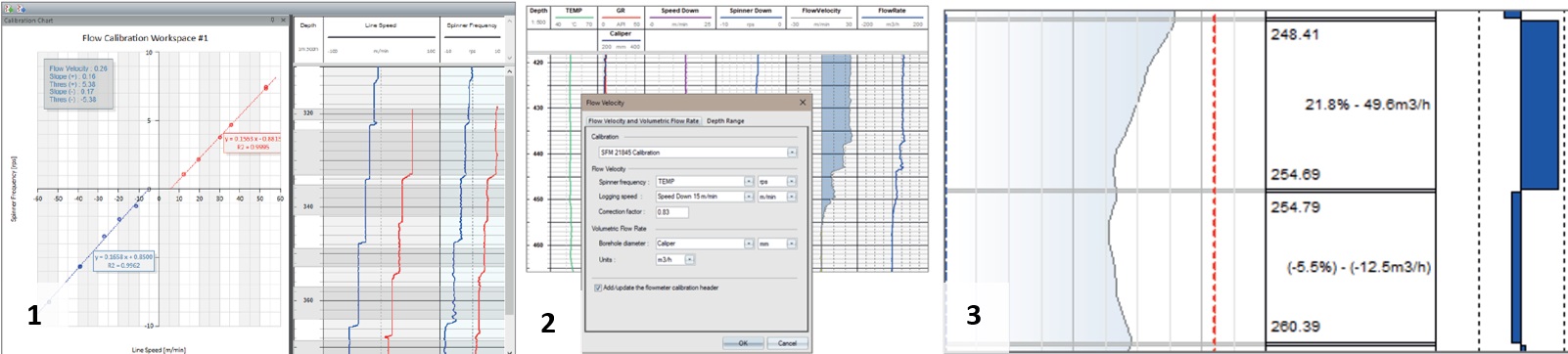
The Basic module and flowmeter workspace has upgraded functions which improve the data analysis. The main highlights include CoreCAD (new lithology dictionaries), WellCAD workspace expansion, Spinner flowmeter calibration, Flow velocity plus bulk flow process and flowmeter workspace improvements. Essentially, these will allow the user to assess the speed and spinner frequency curve and supply a linear regression in order to obtain a calibration model which is automatically saved. The flow velocity and bulk flow process allow the user to compute flow velocity from measured spinner frequency data and compensate for logging speed. The workspace can handle in-flow and out-flow situations - with a new simple SHIFT + left click function.
Fig 2 Shows the new structure features 1) Spinner flowmeter calibration, 2) Flow velocity plus bulk flow process 3) Flowmeter workspace. All images courteously provided by ALT.
There are many more features including the fullwaveform sonic module for cement bond index and compressive strength process (signal attenuation comparison in partially cemented zones) along with the automation module for the integrated script editor (visualisation of Visual Basic Scripts). There are further developments to enable python script support later in 2022 known as pyWellCAD although a beta option will be available in WellCAD 5.5.
Fig 3 Shows the new structure features 1) Fullwaveform Sonic Module, 2) Script Editor automation module. All images courteously provided by ALT.
Please note that ALT will be hosting a number of free webinars in the upcoming week to highlight these new features - These are free webinars which are around 30-45minutese each, please register your interest!
3/15/2022 10:00AM Time zone: (UTC +08:00) Singapore, Perth; Language: English
3/15/2022 10:00AM Time zone: (UTC +01:00) Amsterdam, Berlin; Language: English
3/16/2022 09:00AM Time zone: (UTC -5:00) Bogota, Lima; Language: Spanish
3/17/2022 03:00PM Time zone: (UTC +01:00) Amsterdam, Berlin; Language: French
3/17/2022 03:00PM Time zone: (UTC -05:00) Eastern Time (US & Canada); Language: English
If you would like a link to these webinars, please drop an email to sales@geomatrix.co.uk.
New RT30MKII- manufactured by Georadis
3 February 2022
Image showing the RT30 MKII and its operation - courteously provided by Georadis
As of the start of 2022 Georadis has released the new upgraded RT30-MKII Isotope Identification meter.
Manufactured by Georadis, the RT30 MKII has all of the functions of the RT30 although has a larger sun readable display ensuring the readings can be read easily whilst in the field, its new design ensures all of the electronics are enclosed in a compact, easily portable handheld device. This Isotope identification instrument is designed for field use allowing the user to collect a number of measurements from samples and can be used in a number of applications which include waste/ scrap metal recycling, research labs and production facilities. Its scintillation detection probe uses a photomultiplier tube with up to date silicon photomultipliers technology and a larger detector.
As with the previous model the RT30 MKII integrates a radiation survey, dose meter and radionuclide identification in one compact device and has automatic stabilization on natural background radiation throughout its operation. The meter has an ARM processor and a programmable array (FPGA), this combination allows the meter to handle other sensors at the same time as the gamma ray section (Geiger-Muller counter and Neutron detector - standard offer). It is capable of holding multiple detectors with a maximum detector size of 2” x 2” or 5” with silicon PMT (SIPM or MPPC).
The RT30 MKII can support existing as well as new communication standards with wide compatibility, it is Bluetooth enabled and has its own built in GPS unit for time synchronization, allowing both recorded measurements and GPS measurements to be stored. With an increased sensitivity and a robust design this is an ideal instrument for field geology/ mapping and radiological studies and can also be used in harsh environments.
We look forward to providing you with some further information on the GT30 and GT32 MKII which are coming out later this year mid-summer. These new devices will be suited to more geological and core sampling applications.